
Guide
Planning Poker in Trello
How to run planning poker sessions with your scrum team without leaving Trello. The rules, why it produces better estimates than open discussion, and how to set it up.
What is planning poker?
Planning poker is an estimation technique where every team member votes on the size of a task privately, then all votes are revealed at the same time. If the estimates are close, you pick a number and move on. If they're far apart, you talk about it.
That's basically it. The whole point is to prevent anchoring - the tendency to go along with whatever number someone says first. When the tech lead says "I think this is a 3" before anyone else speaks, suddenly everyone agrees it's a 3. Even the person who was thinking 8.
Why bother? Open discussion works fine.
Does it, though?
Think about your last estimation meeting. Who spoke first? Probably the most senior or most vocal person on the team. And once they threw out a number, did anyone push back?
Anchoring bias is well-documented in psychology and it hits estimation meetings hard. The first number spoken becomes the reference point. Everyone adjusts from there, but rarely enough. A task that should be an 8 becomes a 5 because the tech lead started there.
Planning poker sidesteps this entirely. Everyone commits to a number before seeing anyone else's. The disagreements come out into the open, and those disagreements are where the real value is - they surface misunderstandings, hidden complexity, and different assumptions about scope.
The rules
Planning poker has a few simple rules. Teams sometimes overcomplicate this, so here's the stripped-down version:
1. Someone describes the task
Usually the product owner or whoever wrote the card. Keep it to 30 seconds. If the team has questions, answer them. If the discussion goes past a couple of minutes, the card probably isn't well-defined enough to estimate. Flag it and move on.
2. Everyone votes privately
Each person picks a story point value from the scale (typically Fibonacci: 1, 2, 3, 5, 8, 13). No peeking, no discussing, no "I'm probably going to say 5."
3. Reveal all votes at once
Everyone flips their cards at the same time. This is the moment where planning poker earns its keep.
4. If votes agree: accept and move on
If everyone voted 5 or a mix of 3 and 5, pick the higher number and move on. Don't waste time debating a one-step difference.
5. If votes are far apart: discuss
The person who voted lowest and the person who voted highest each explain their reasoning. Usually one of them knows something the others don't. Maybe the low voter has done this exact thing before and knows a shortcut. Maybe the high voter spotted an edge case everyone else missed.
After a quick discussion (2 minutes max), vote again. It almost always converges on the second round.
What counts as "far apart"?
A gap of two or more Fibonacci steps. So 3 vs. 5 is fine - just take the 5. But 3 vs. 8, or 2 vs. 13? That means people are imagining completely different tasks and you need to talk.
If after two rounds the team still can't agree, just go with the higher number. Spending 10 minutes debating an estimate defeats the purpose.
Running planning poker in Trello
Traditionally, teams use physical cards or a separate web app for planning poker. That means context-switching away from your Trello board to another tool, then copying the result back. Not ideal.
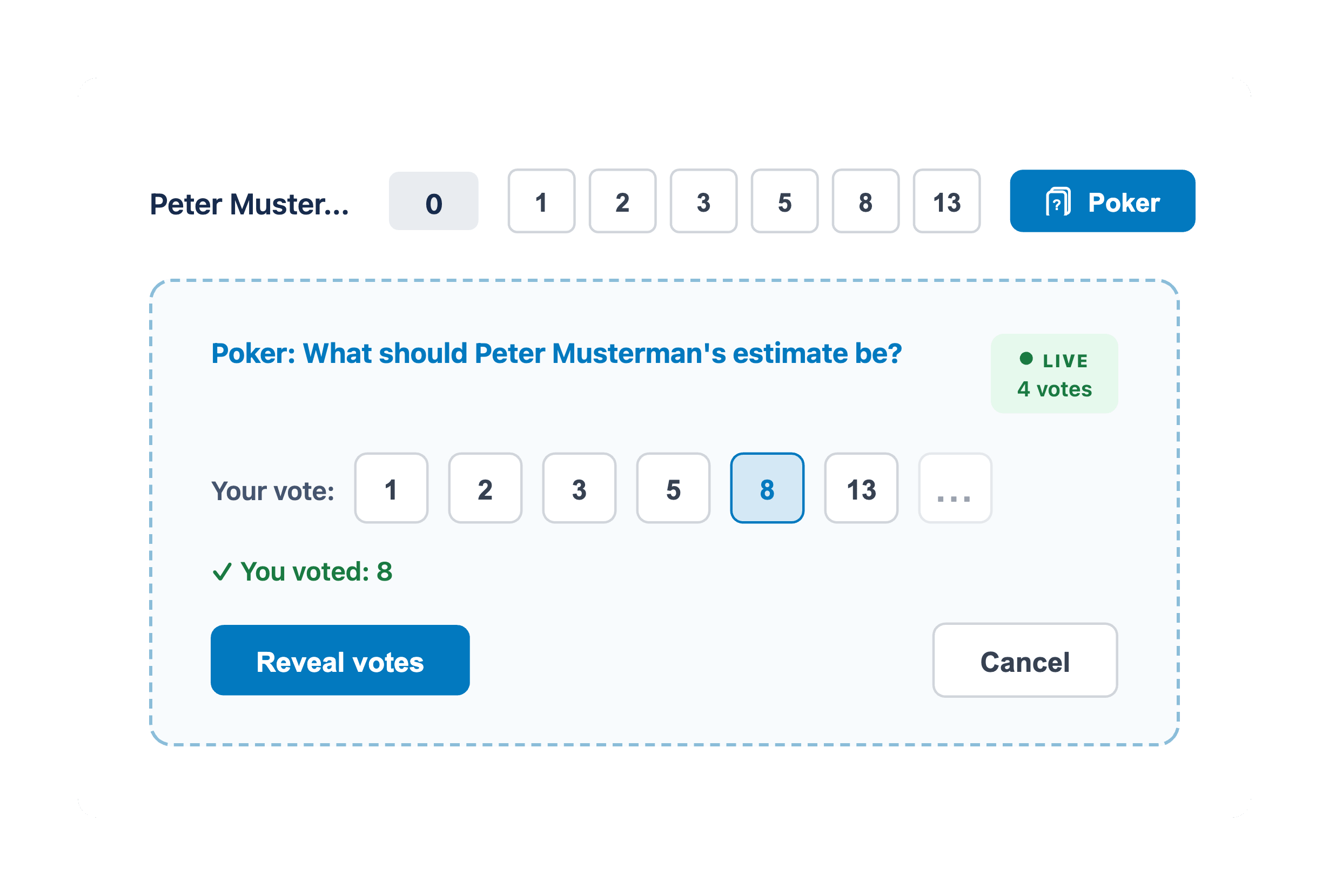
With EstiMate, planning poker runs directly inside the Trello card. Open a card, start a poker session, and team members vote right there. No extra tabs, no copying numbers around.
The flow:
- Open a card and click the poker icon next to any member
- Team members open the same card and see the voting interface
- Everyone picks a value - votes stay hidden until revealed
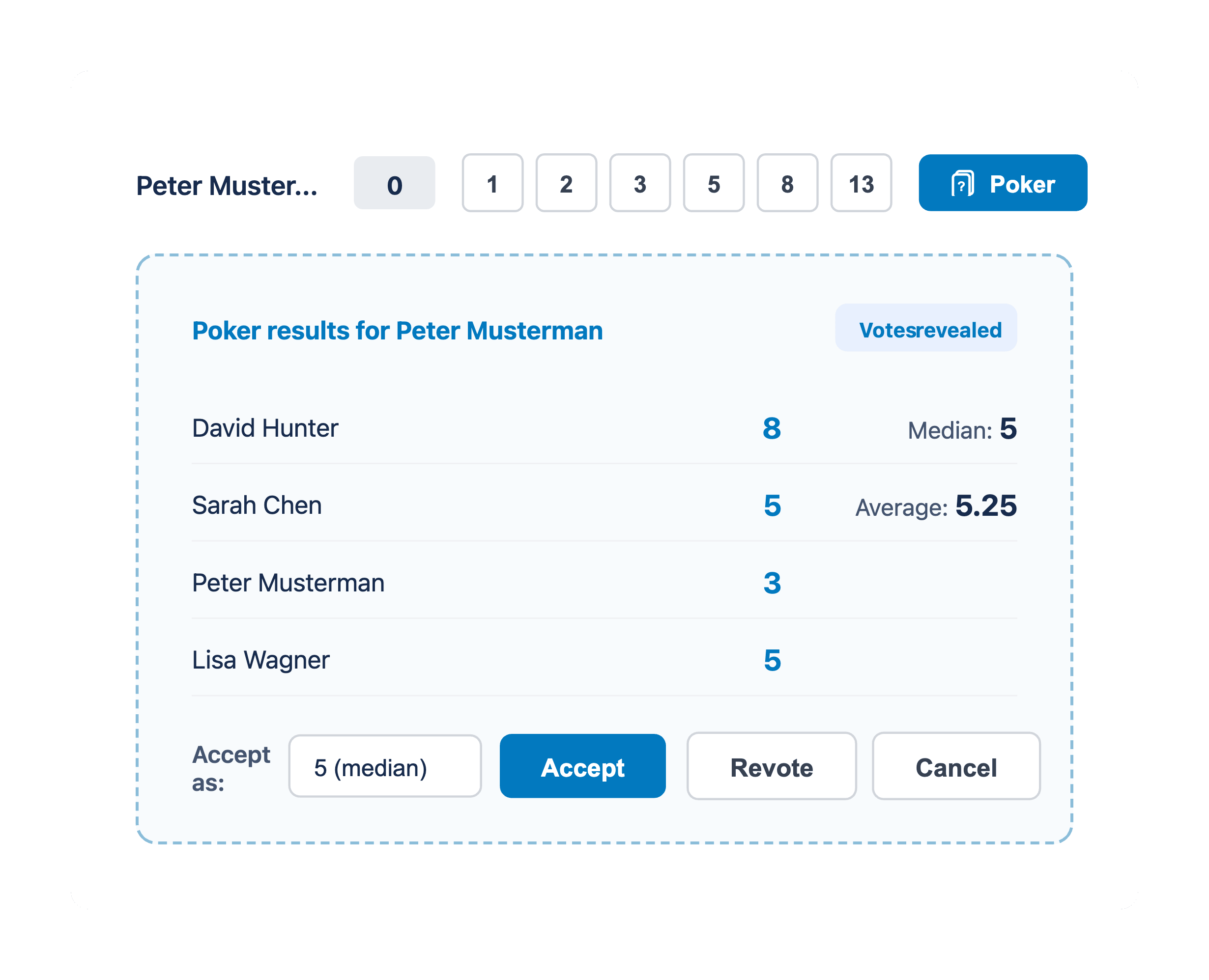
- The session starter reveals all votes at once
- You see each person's vote, plus the median and average
- Accept a value (defaults to the median), or re-vote if needed
Accepting writes the estimate directly to the card. No manual step.
Tips for better sessions
Timebox ruthlessly. Two minutes per card for voting + discussion. If you have 20 cards to estimate, that's 40 minutes. Totally doable. Without a timebox, the same 20 cards can take 2 hours because the team goes down rabbit holes on every third card.
Estimate the backlog, not just the sprint. Teams often only estimate cards during sprint planning. By then it's too late - you're trying to plan and estimate at the same time, which makes both worse. Run a short estimation session mid-sprint for upcoming backlog items. 15 minutes, knock out the top 10-15 cards. Then sprint planning is just picking, not debating.
Skip the tiny stuff. If everyone can see that a card is a 1, just mark it as 1 and move on. Don't run a full poker round for fixing a typo. Save the process for cards where the size isn't obvious.
Use the disagreements. When votes are 3 and 13 on the same card, that's not a problem - that's the most valuable thing that happened in your meeting. Someone has information the rest of the team doesn't. Dig into it. These conversations prevent surprises mid-sprint.
Planning poker for remote teams
Originally, planning poker used physical cards in a room. Obviously that doesn't work for remote teams. A lot of remote teams use screen-sharing with a dedicated poker app, which is clunky - you're sharing a screen of a tool to discuss a card in a different tool.
Running poker inside Trello fixes this. Everyone's already looking at the card. You can read the description, check the comments, and vote without switching context. On a video call, the facilitator shares their Trello board, reveals the votes, and the discussion happens naturally.
Works for async teams too. Start a session, let people vote over the next hour, then reveal when everyone's in. Not as fast as a live session, but better than skipping estimation entirely because you can't get everyone on a call.
When not to use planning poker
Planning poker adds overhead. For a team of 3 working on well-understood tasks, open discussion might be enough. If your estimates rarely differ by more than one step, you probably don't need the ceremony.
It's most valuable when:
- Your team has more than 4 people (harder for everyone's voice to be heard)
- There's a mix of seniority levels (anchoring bias is stronger)
- You're estimating unfamiliar work where assumptions vary
- Estimates have been unreliable and you want to improve them
If none of that applies, save yourself the 30 seconds per card and just discuss openly. Use planning poker where it matters.
Getting started
Try it on 5 cards in your next estimation session. That's enough to see whether it surfaces useful disagreements on your team. If it does, keep going.
Add EstiMate to your Trello board - planning poker runs right inside the card, so there's nothing extra to set up.
Keep reading
- How to Estimate Story Points in Trello - choosing scales and estimating per member
- Trello Sprint Planning Guide - use your estimates to plan and run sprints
- Burndown Charts for Trello - track sprint progress after estimation
- How to Set Up Trello for Scrum - board structure, ceremonies, and common pitfalls
- How to Track Team Velocity in Trello - measure and use your team's sprint velocity
- Capacity Planning for Trello Teams - plan sprint capacity based on team availability
- What 1,000 Trello Teams Taught Me About Estimation - patterns I keep noticing across teams
Want to try planning poker with your team?
EstiMate runs planning poker sessions right inside Trello cards. No extra tools, no context switching.
Add EstiMate to Trello